A graphics reel for Mark Achbar's documentary, drawn in code. The director is reviewing it. It is not a commission.
Sound on. Every stroke, stamp and tick has its own sound. This page always shows the newest cut, and the timestamps below jump the reel to each plate.
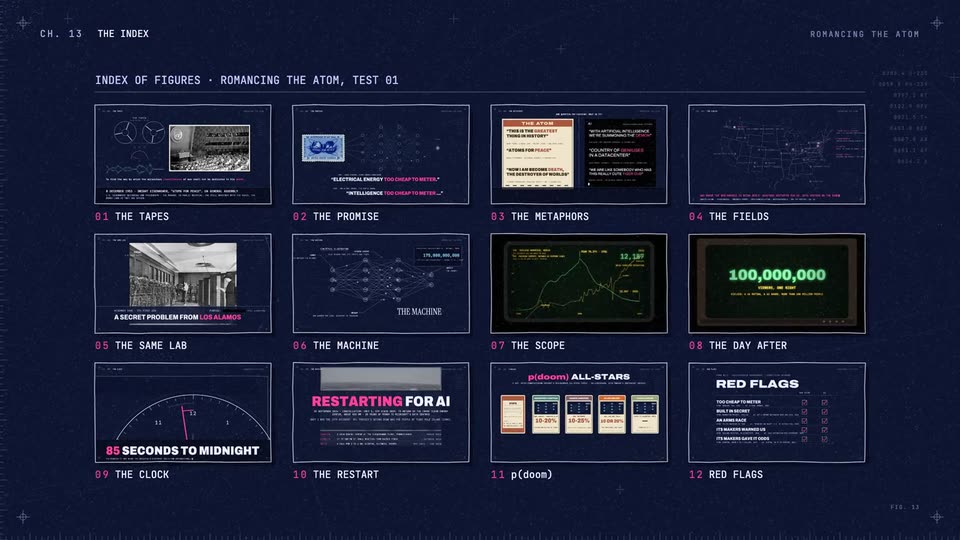
Romancing the Atom is Mark Achbar's next documentary, and it sets nuclear weapons beside AI: two technologies sold on the same promises and warned about by the people who built them. We made this 172-second reel on spec to show the kind of animated sequences the film could carry.
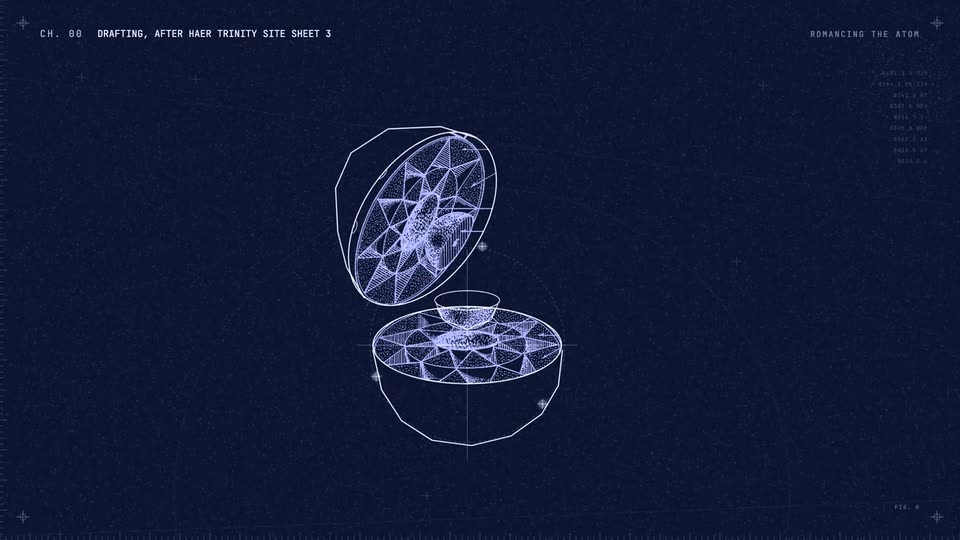
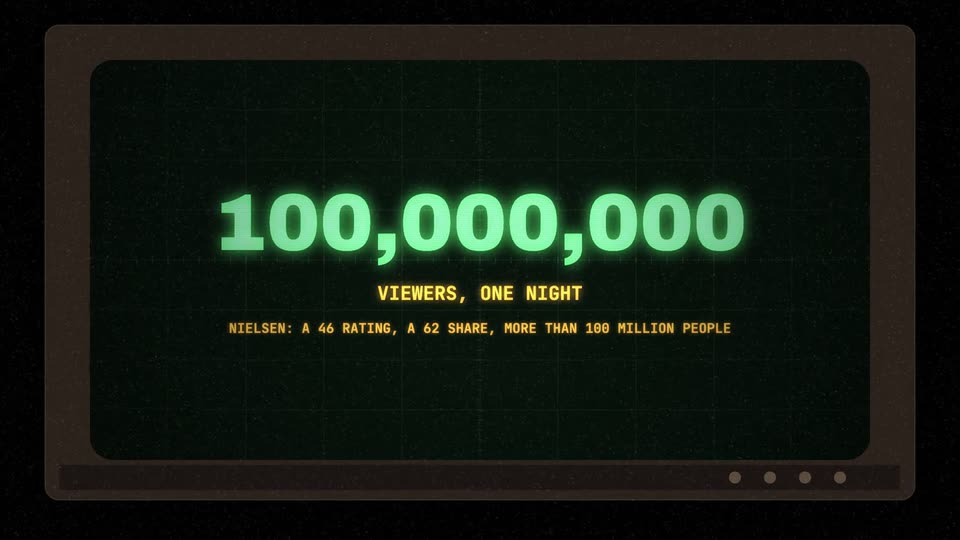
The whole reel is one engineering sheet: navy paper, cyan and lavender linework, and magenta saved for the one phrase on each plate that matters most. It opens by drafting the 1945 Trinity bomb sheet line by line, then sweeps the scanned original in underneath to show the match. Each of the fourteen plates hands over to the next instead of cutting. A photograph slides into a stamp's place, a neural network collapses into an oscilloscope's beam spot, and the scope's tube turns into a 1983 television.
Listen as well as watch. Every sound effect is synthesised in code from the animation's own events, so each one lands on the thing it belongs to: the drafting pen on paper, a typewriter key for every letter, the thump of a stamp, relays clicking, a television warming up, the clock's ratchet, cards dealt onto the table. When the oscilloscope draws the warhead curve, a tone rises and falls with it. The music underneath is a generated score, Atom Drive, made with ElevenLabs Music.
A documentary graphic is a claim, so the reel only says what it can back up. Most plates set a nuclear-age fact against its AI-age echo:
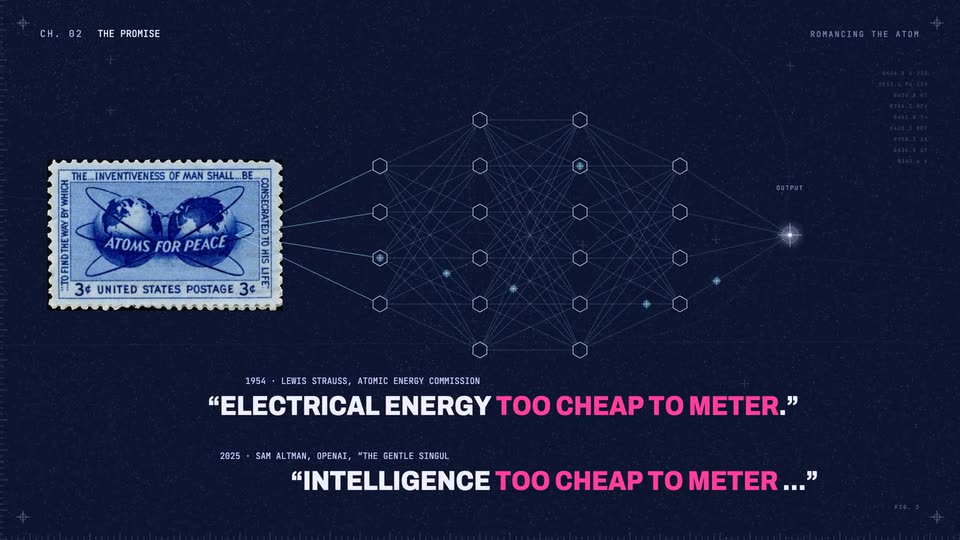
"Too cheap to meter", said of electricity by the chairman of the U.S. Atomic Energy Commission, and of intelligence seventy years later. The shared words are boxed and measured.
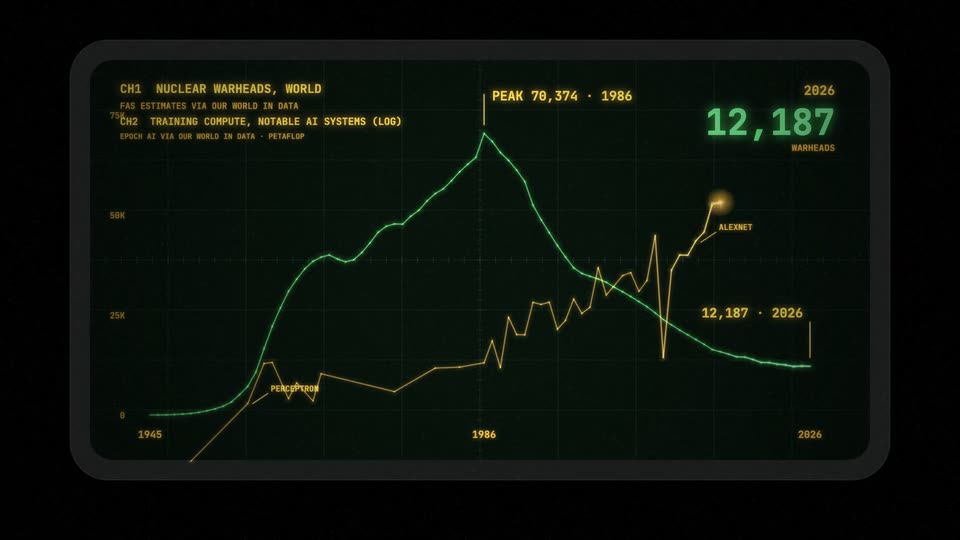
The FAS stockpile estimates, 70,374 at the 1986 peak and 12,187 today, traced on an oscilloscope beside the compute used to train notable AI systems (Epoch AI).
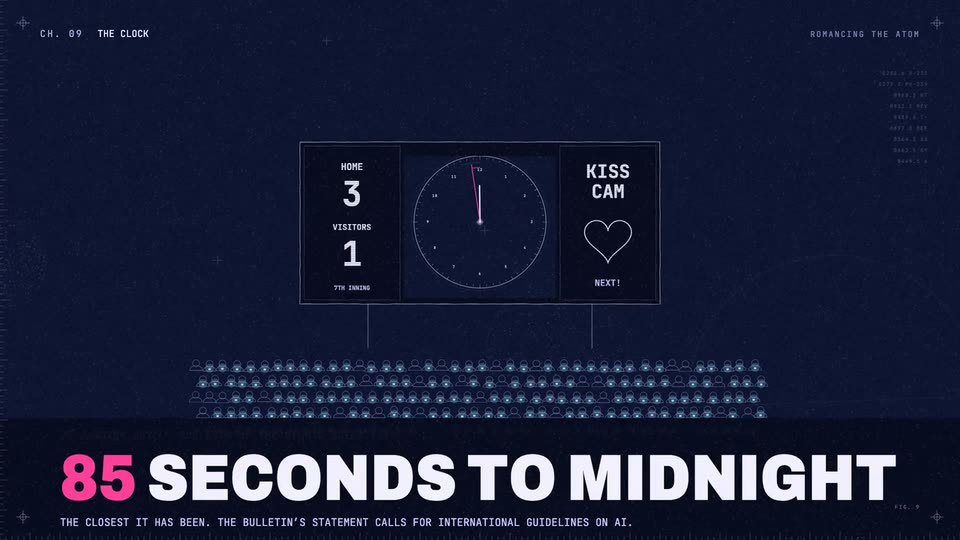
Seven minutes at its first setting, 85 seconds now, the closest it has been. The 2026 statement asks for international guidelines on AI.
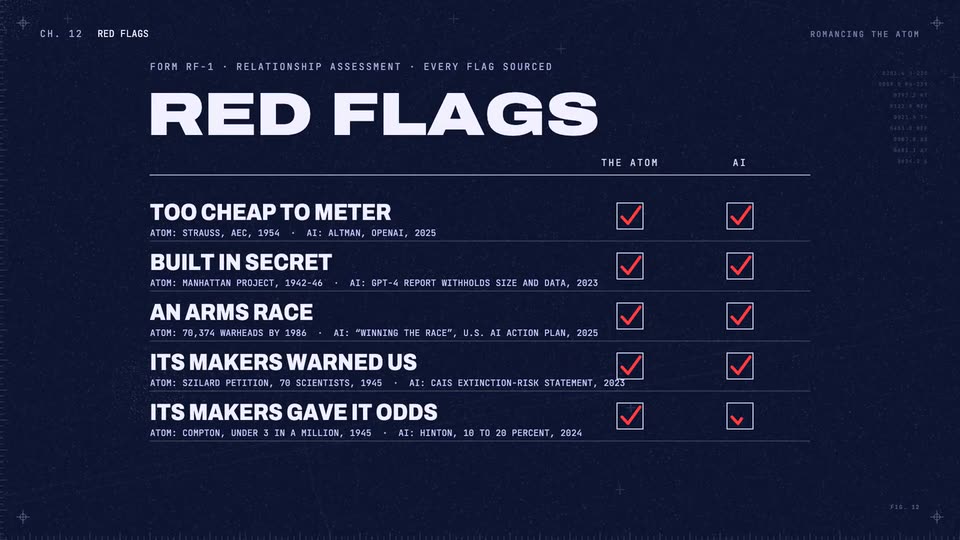
70 Manhattan Project scientists warned against using the bomb. In 2023 the people building AI signed a warning of their own.
Where the record runs out, so does the reel. ENIAC's first job in December 1945 was a secret problem from Los Alamos, and its content is still classified, so the purpose field on screen is redacted rather than guessed.
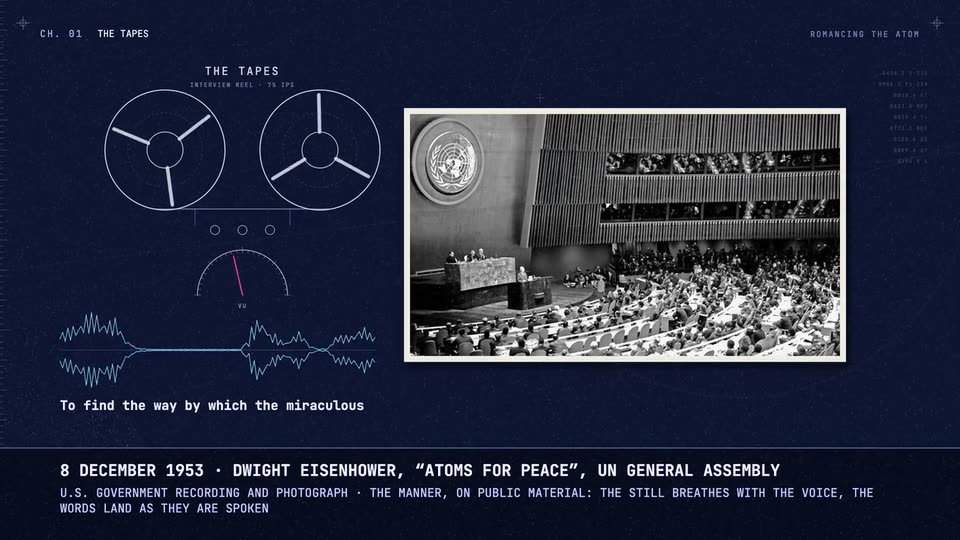
The photographs are public domain: Trinity, ENIAC, Three Mile Island, and Eisenhower at the UN in 1953 with his own recording playing under him. The drawings are declassified Hanford and Trinity sheets from the Library of Congress, shown as scanned before they turn into linework. The map of weapons sites pins the places Robert Del Tredici photographed for his 1987 book At Work in the Fields of the Bomb. No photograph is recoloured, and no frame was generated. Everything else is canvas code.
Nine drafts over two days, each one watched and noted before the next.
Romancing the Atom (opens in a new tab) is a feature documentary directed by Mark Achbar and produced by Betsy Carson at Invisible Hand Productions, in production with Knowledge Network and TVO. It is based on the images and interviews of Robert Del Tredici, who has photographed the nuclear age for five decades. The film looks at the ethical, environmental and political cost of nuclear weapons, past and future, and draws a line from the bomb's chaotic early years to the unchecked rise of AI.
Achbar co-directed Manufacturing Consent (opens in a new tab), the 1992 portrait of Noam Chomsky, and The Corporation (opens in a new tab) (2003), and has made or executive-produced over a dozen feature documentaries.
Follow the film at Invisible Hand (opens in a new tab)