How we made the music video.
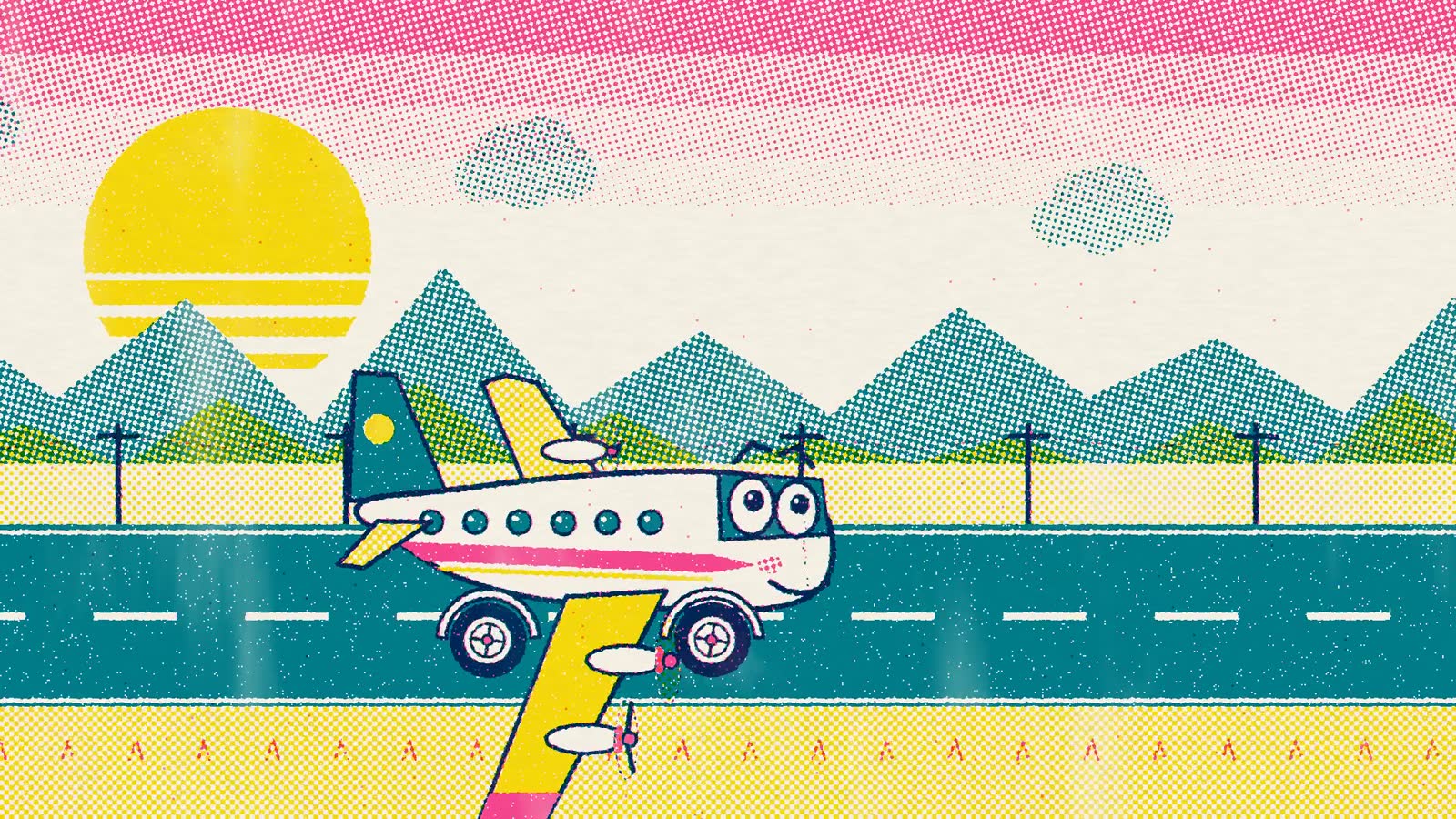
Bob Wiseman sent us six new songs and an open brief: pick any of them. We chose Airplane on the Highway, the least conventional of the six. It runs 6:07, opens with seventy seconds of overheard voices, and ends in an improvised monologue about destiny. Bob called it a cross between the avant-garde and straighter songwriting. We drew every frame of it in code.
We started with look tests, not a storyboard. We made fourteen styles, each a short clip cut to the real track: risograph, woodcut, kinetic type, kawaii watercolour, oscilloscope, cut-paper silhouettes, a junkyard collage and more. Bob picked four of them (risograph, woodcut, kinetic typography and kawaii). We added two of our own: a 16-bit racer for the third rumour, and a rotoscope dream for the long soundscape at the end.
Each style became a world with its own version of the plane. The map below is the whole song, coloured by world.
The plane sleeps in a garage while a flight recorder transcribes the voices in his dream. Then the door rolls up and he pulls onto the highway.
The colour prints in on the first sung word.
The rumours, carved like an old legend from a time when planes flew.
The verses, in wobbly marker and watercolour, with the backup singers' na-na-nas written across the sky.
The third rumour becomes a racing game. The passing lane is locked.
The improvised monologue, drawn as if traced over film, with every line drifting loose.
Bob's first note on the draft mattered most. The style changes felt random, he said, and random reads as AI. So we turned every change into a place the plane drives through. He enters a tunnel in one world and comes out of it in the next. A car wash scrubs the ink off him into watercolour. A toll booth flips to INSERT COIN and the world pixelates from the gate. We took the idea from Sesame Street's Pinball Number Count, where you follow the ball through every tunnel.
Most of the changes happen through drawn portals. Where two worlds had to melt into each other, we generated a short bridge from the last frame of one to the first frame of the next. The final cut has 23 of them, among them the saxophone that rises out of an ink storm and the screen that cracks open into the dream. For the last two minutes, every scene flows into the next.
He drives into a tunnel in risograph and comes out carved in wood.
An ink storm gathers and a saxophone rises out of it.
Turbo works too well. The racing game breaks open into the dream.
The mandala opens like petals and the plane flies out of its centre.
A paper panel swings open onto the next scene.
Bob sent eleven notes on the draft, and every one of them made the final cut. Some of them:
The drawing itself cost nothing but render time.